

For information relating to the labelling of food products, visit the Canadian Food Inspection Agency’s website.
Join us on June 4 from 12:30 – 1:30 EDT to learn more about competition law and Made in Canada claims.
What you should know
As many consumers shop for Canadian-made products, it’s important that businesses be truthful about their labelling and marketing claims.
Businesses must ensure that their claims accurately reflect the production or activity that takes place in Canada.
The Competition Bureau enforces laws that address false and misleading advertising in the marketplace, including deceptive claims about the origin of products. We are not a regulator and we do not mandate what a company must include on its products.
When looking at a claim, to determine if it is false or misleading, we consider the general impression conveyed to a consumer. For example, we may look at the details of a claim, such as its use of words, visual elements, illustrations and overall layout, which may alter its meaning.
Made in Canada vs Product of Canada
At what point can businesses market their products as Canadian-made?
We have guidelines to help businesses make sure their “Made in Canada” and “Product of Canada” claims are truthful. In short:
"Made in Canada" claims
We will generally not challenge a claim that states that a good is "Made in Canada" if these three conditions are met:
- at least 51% of the total direct costs of producing or manufacturing the good have been incurred in Canada;
- the last substantial transformation of the good occurred in Canada; and
- the claim is accompanied by an appropriate qualifying statement, such as "Made in Canada with imported parts" or "Made in Canada with domestic and imported parts".
"Product of Canada" claims
We will generally not challenge a claim that states that a good is a "Product of Canada” if these two conditions are met:
- at least 98% of the total direct costs of producing or manufacturing the good have been incurred in Canada; and
- the last substantial transformation of the good occurred in Canada.
Keep in mind that we do not approve or certify such claims.
For information about precious metals marking, consult our guide.
Information for businesses
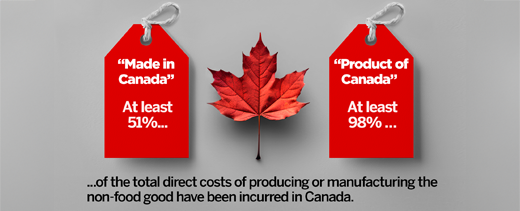
Description
Canadian flag with a red maple leaf in the center. Both sides are represented by red labels with signs explaining the requirements for 'Made in Canada' and 'Product of Canada' claims.
- You are not required to identify the country of origin of your products. If you do, the information must be accurate and truthful.
- Before making any types of claims about the origin of a product, consult our "Product of Canada" and "Made in Canada" Guidelines.
- Your labelling and marketing claims must accurately reflect the production or activity that took place in Canada.
- If a product does not meet the criteria above, use a more specific term that accurately describes the process that took place in Canada, such as “Assembled in Canada” or “Designed in Canada”.
- Canadian symbols, colours or logos used in a deceptive way could raise concerns under the law.
Information for consumers
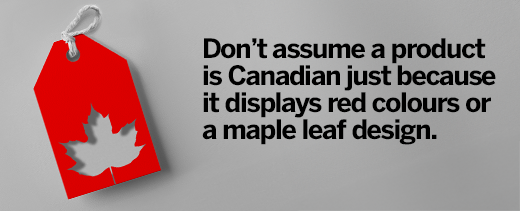
Description
Red label with a white maple leaf and black text indicating not to assume that a product is Canadian just because it features red or a maple leaf.
- False or misleading advertising can raise concerns under the law.
- Don't assume a product is Canadian just because it displays red colours or a maple leaf design.
- If a business makes a claim about the origin of their product, it needs to be accurate and truthful.
- When in doubt, reach out to the manufacturer or retailer for further clarification on their product claims.
Report deceptive marketing
We encourage anyone with information about a potential false or misleading marketing activity to report it to us. We treat all complaints confidentially.